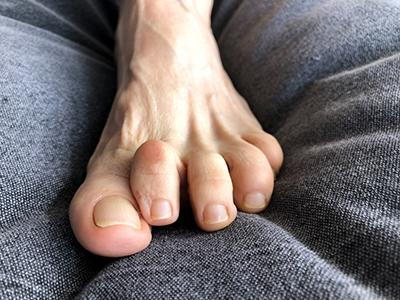
Bunions rarely announce themselves. You reach for shoes you have worn for years and one rubs along the inside edge of your foot in a way it did not last season. The bump where your big toe meets the foot aches by the end of a shift, and the toe has started leaning toward its neighbor. That drift is a bunion (hallux valgus). Correcting the alignment is a surgical question, but most of what decides how much it bothers you day to day happens outside our office.
What Is Actually Changing Inside Your Foot
The bump is not new bone piling up on the side of your foot. It is the head of the first metatarsal, the long bone behind your big toe, becoming prominent as the joint shifts out of line. The metatarsal angles one way while the toe angles the other, and over years the joint capsule and tendons settle into that position. This is why a bunion moves slowly and does not straighten out on its own.
The structure you inherited does most of the work: loose joints, a first metatarsal at a wider angle, an arch that flattens under load. Narrow pointed shoes and years in heels do not create the problem, but they push a vulnerable joint along faster.
Shoes Do More Than Any Product on the Shelf
If you change one thing, change your shoes. A shoe that clears the joint beats every gadget marketed to bunion sufferers.
- Have both feet measured for length and width. Width is where most people go wrong, and sizing varies by brand
- Take the insole out and stand on it. If your foot spills over the edge, that shoe will press on the joint
- Run your thumb across the widest part with the shoe on. If you can trace the bump through the material, it is too narrow
- Keep heel height under about an inch and a half, since height slides weight onto the joint that hurts
- A firmer sole with a slight rocker lets you roll through a step without bending the joint as far
- A cobbler can punch a stretched spot into leather over the bump, which rescues shoes you already like
The Rest of the Daily Routine
- Lay a non-medicated felt or gel pad over the bump before your shoe goes on. Skip medicated corn pads, since the acid is hard on skin
- A silicone spacer between the first and second toe will not change alignment, but many find it eases a long day
- Ice the joint about fifteen minutes after you have been on your feet, with a cloth against your skin
- Stretch your calves daily, because a tight calf keeps pressure on the front of the foot
- Leave the callus over the joint alone. Shaving it with a blade is a common way a bunion turns into an infection
Worth saying plainly: no sleeve, spacer, splint, taping method, or exercise straightens the joint. Anything sold on that promise is overselling. What they do is make your foot comfortable and slow how fast symptoms build.
Staying Active Without Setting It Off
You do not have to give up exercise, only be selective while the joint is irritated. Swimming, cycling in a stiff-soled shoe, rowing, and the elliptical ask far less of the big toe joint than running or court sports. If you run, look for a generous forefoot and a rocker, and ease off hills and speed work. If your workouts happen barefoot, a thin toe sleeve gives the joint padding.
Strength work helps how your foot functions, though it will not reshape the joint. Slow calf raises, single leg balance, and short foot exercises keep the arch carrying its share.
When It Is Time to Do More
Self-management stops being enough at recognizable points. Make an appointment if any of these describe you.
- The joint hurts most days, wakes you at night, or aches when you are off your feet
- You feel burning or numbness over the bump, which suggests the nerve there is being squeezed
- The second toe is beginning to lift, cross over, or curl
- A callus is building under the ball of the foot behind the second toe, a sign load has shifted
- The skin over the bump is breaking down, or you have diabetes or neuropathy
- You can no longer find shoes you can wear for a full day
A joint that turns red, hot, and swollen within hours is a different problem, not a bunion flare, and should be seen promptly.
At your visit we check how the joint moves and take digital X-rays on site at our Fredericksburg office to measure the angles. Custom orthotics, scanned in our office, often come next because they change how pressure spreads across the forefoot. If the joint has moved past what conservative care can hold, our bunion treatment page covers the procedures our surgeons use. Operating room cases are performed at Stafford Hospital.
Let Us Take a Look Before It Gets Harder to Treat
Bunions are easier to live with when someone measures the joint and watches it over time. Rappahannock Foot & Ankle Specialists has cared for this community since 1986, and our six podiatric surgeons see patients at 195 Falcon Drive in Fredericksburg, (540) 371-3338, and 450 Garrisonville Road in North Stafford, (540) 659-5067. Call whichever office is closer, or request an appointment.