
Serving Fredericksburg and Stafford since 1986
Ankle Surgery & Reconstruction in Fredericksburg, VA
Board-certified and board-eligible surgeons repairing ligaments, tendons, and joints, with your physical therapy team in the same office for the entire recovery.
☎ Fredericksburg: (540) 371-3338
☎ North Stafford: (540) 659-5067
Rearfoot & ankle reconstruction training • In-house physical therapy • Since 1986 • 900+ five-star reviews
The Ankle That Never Fully Healed
Most ankle surgery patients do not arrive after one dramatic injury. They arrive after years of a familiar story: a bad sprain in high school, a few more over the years, each one “healed,” and an ankle that has quietly never been the same since. It rolls on uneven ground. It aches after activity. You catch yourself scanning the trail for roots, choosing the escalator, not quite trusting it on the stairs. That is not clumsiness and it is not just age. It is usually one of a handful of specific, diagnosable, treatable problems.
Ligaments stretched by repeated sprains stop doing their job as the ankle’s seatbelts, a condition called chronic lateral ankle instability. Tendons that run behind the ankle bones, the peroneals and the Achilles, develop tears and degeneration that rest alone rarely resolves. Cartilage injured in old sprains wears into early arthritis. Each of these has a distinct treatment path, and the first job of your evaluation is telling them apart, which is why we combine a hands-on exam with digital X-rays and in-office ultrasound before anyone talks about an operating room.
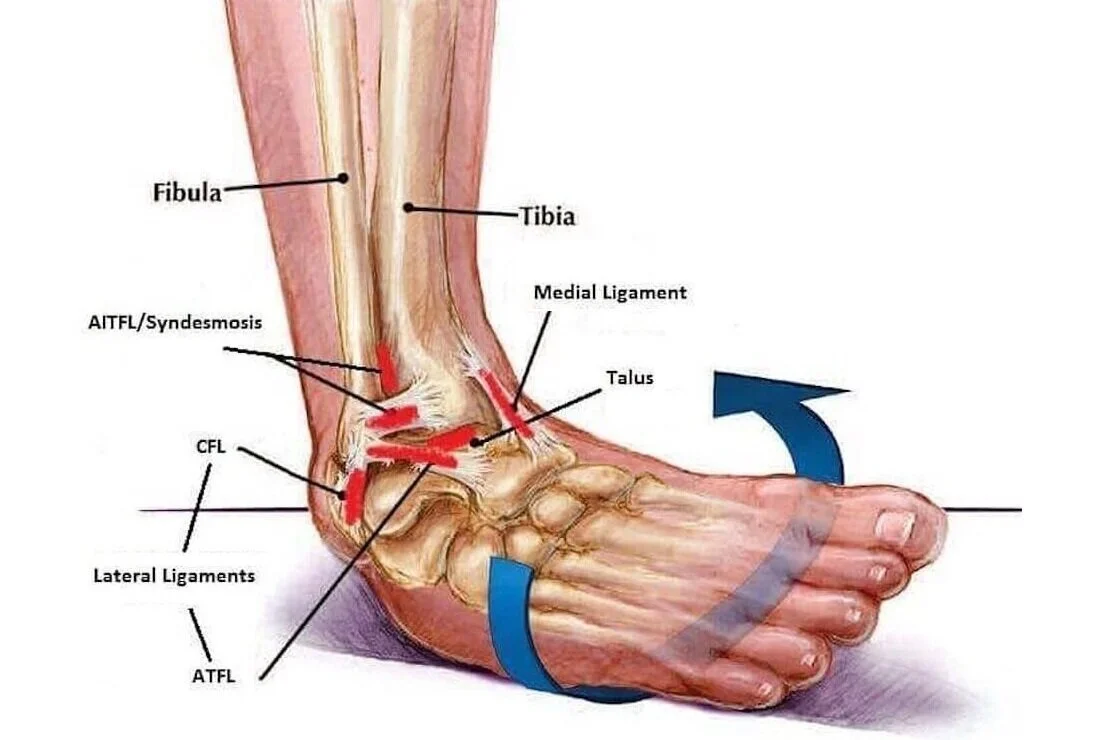
The lateral ligaments and tendons most often damaged by repeated sprains.
What We Treat Surgically
Chronic ankle instability
Stretched-out ligaments from repeated sprains, leaving an ankle that gives way. Repaired by tightening and reinforcing the ligaments.
Tendon tears and degeneration
Peroneal and Achilles problems that cause pain, weakness, and swelling behind or below the ankle bones. Repaired openly or with minimally invasive techniques.
Fractures
From simple breaks to complex injuries, managed from first X-ray through final therapy visit in one practice.
Ankle arthritis
Worn cartilage, often the legacy of old injuries, treated in a ladder from bracing and injections to surgical options.
Sprain vs. Instability vs. Tendon
| Feature | Recent Sprain | Chronic Instability | Tendon Damage |
|---|---|---|---|
| The story | One clear injury, days to weeks ago | Multiple sprains over years; ankle “gives way” | Pain and swelling behind/below the ankle bone, worse with activity |
| Key symptom | Swelling, bruising, pain with weight | Not trusting the ankle; rolling on flat ground | Weakness, aching, sometimes a popping feeling |
| First-line care | Protection, rehab, then progressive return | Bracing and targeted physical therapy | Immobilization, therapy, addressing mechanics |
| When surgery enters | Rarely; only for severe combined injuries | When the ankle still gives way after real rehab | When imaging shows tears that conservative care cannot heal |
An improperly rehabilitated sprain is a common way instability begins, which is why we take a “just a sprain” injury seriously from the first visit.
You’ve Probably Already Tried…
Drugstore ankle braces and neoprene sleeves. Taping before basketball or hikes. Balance exercises from a physical therapy stint, or from YouTube. Stiffer boots and high-top shoes. Ibuprofen and ice after the ankle “acts up.” Simply avoiding the activities that set it off, which works right up until you miss them.
The honest assessment: bracing and balance training are legitimately the first-line treatment for an unstable ankle, and a meaningful share of patients stabilize with a properly structured program, which our in-house therapy team runs. But a brace supports stretched ligaments rather than shortening them, and strengthening alone will not reattach a torn tendon. When you have done real rehab and the ankle still gives way, the ligament or tendon itself usually needs repair, and further sprains can add cartilage damage over time.
When to See a Specialist
Come in when your ankle has given way more than once in the past year; when you are still guarding it months after a sprain; when there is persistent swelling, weakness, or pain behind or below the ankle bone; when a “sprain” from weeks ago still will not bear weight normally, since occult fractures and tendon tears hide inside that story; or when you have simply stopped trusting the ankle. And after any acute injury with real swelling, get X-rays promptly; we hold same-day urgent slots for exactly this.
Each additional “giving way” episode can add wear to the cartilage, and that damage often builds quietly. If your ankle is giving way, it is worth having it looked at.
New injury? Same-day urgent appointments available.
Call Fredericksburg at (540) 371-3338 or North Stafford at (540) 659-5067, or request an appointment online.
☎ Fredericksburg: (540) 371-3338
☎ North Stafford: (540) 659-5067
Treatment Options
Non-Surgical Care
Structured rehabilitation
Balance, proprioception, and peroneal strengthening with our in-house physical therapy team, the evidence-based first line for instability.
Bracing
From athletic stirrup braces to custom devices, matched to your activity and degree of laxity.
Custom 3D orthotics
When your foot mechanics predispose you to rolling, orthotics from an in-office 3D scan address the root cause.
Injections and imaging-guided care
Targeted anti-inflammatory treatment for arthritic and tendon pain, delivered with in-office ultrasound precision.
Surgical Care
Lateral ligament repair
The stretched ligaments are tightened, repaired, and reinforced to restore stability, typically as an outpatient procedure. It is the usual next step for chronic instability that has not settled with bracing and rehab, and most patients, including athletes, return to full activity.
Tendon repair, including minimally invasive techniques
Torn or degenerated peroneal and Achilles tendons are cleaned up and repaired. Where the injury pattern allows, minimally invasive approaches mean smaller incisions, less soft tissue trauma, and faster rehab.
Fracture surgery
Operative fixation when breaks are displaced or unstable, with the same practice managing you from injury through final physical therapy session.
Arthroscopy and arthritis procedures
Scope-based cleanup of cartilage injuries and impingement, and staged options for the arthritic ankle.
What to Expect After Ankle Surgery
1
Protection phase (roughly weeks 0 to 4)
Boot or cast, limited weight-bearing per your specific procedure, swelling management, elevation.
2
Motion and strength phase (roughly weeks 4 to 10)
Out of the boot and into structured physical therapy with our in-house team: range of motion, strength, then balance retraining.
3
Return phase (roughly months 3 to 6 for sport)
Progressive return to running, cutting, and sport against objective milestones, not the calendar alone. Ligament repair patients commonly return to sport in this window; tendon repairs vary with the tear.
Why Patients Choose Rappahannock Foot & Ankle Specialists
Ankle outcomes depend on two things: the operation and the rehabilitation that follows. Here both happen under the same roof, with your surgeon and your physical therapist working from the same chart and adjusting your program as you progress. Our board-certified and board-eligible podiatric surgeons trained specifically in rearfoot and ankle reconstruction, our diagnostics, ultrasound and digital X-ray, live in the office, and we have been putting this region back on its feet since 1986.
Meet the Surgeons

Dr. Michael Donato
Co-owner

Dr. Sunshine Brady-Thomas

Dr. Joel Zarzuela

Dr. Martha Hurley

Dr. Neelum Patel

Dr. Jessica Somma

Dr. Stephen Carley
Emeritus
What Our Patients Say
Frequently Asked Questions
My ankle keeps rolling. Do I need surgery?
Not necessarily, and we do not start there. A structured program of bracing and balance-focused physical therapy stabilizes many ankles, and ours runs in-house. Surgery enters the conversation when the ankle still gives way after genuine rehab, because at that point the ligaments themselves are the problem.
What actually happens in ligament repair?
Through a small incision, the stretched lateral ligaments are tightened and stitched back to proper tension, often reinforced with adjacent tissue or augmentation. It is typically outpatient, followed by a boot and progressive therapy. Most patients find the ankle feels steadier again once rehab is complete.
How long until I can play sports again?
For ligament repair, most athletes return to sport in roughly three to six months, cleared by strength and balance milestones rather than the calendar. Tendon repairs vary more with the size of the tear. You will have a specific, staged plan before surgery is ever scheduled.
I sprained my ankle weeks ago and it still hurts. Is that normal?
It is worth having checked. That story often turns out to be something more than a sprain: a small fracture, a cartilage injury, or a peroneal tendon tear. A sprain that is not clearly improving by two to three weeks deserves an X-ray and a proper exam.
Can an old ankle injury from years ago still be fixed?
Very often, yes. Chronic instability and tendon damage tend to persist rather than settle on their own. If you have spent years working around the ankle, an evaluation is still worthwhile, since a well-defined outpatient repair is often an option.
Do you treat broken ankles?
Yes, from urgent same-day evaluation of new injuries through surgical fixation when the fracture requires it, and on through physical therapy in our office. One team, one chart, start to finish.
Podiatrist or orthopedist for ankle surgery?
Our board-certified and board-eligible podiatric surgeons have rearfoot and ankle reconstruction training, and the foot and ankle are their focus. The same surgeon also directs your bracing, orthotics, and in-house rehab, so your care stays with one team from start to finish.
Does insurance cover ankle surgery?
Yes, surgical treatment of instability, tendon tears, and fractures is standard covered care when medically necessary. We verify your benefits before scheduling and tell you exactly what to expect.
What happens if I keep just wearing a brace?
For some patients, bracing is a legitimate long-term answer, and we will say so when it is. The consideration is what each additional giving-way episode can do to your cartilage, since instability is a leading route to ankle arthritis. We will walk you through that trade-off so you can decide with the full picture.
How do I know if it’s my tendon?
Pain, swelling, or weakness behind or just below the outside ankle bone, especially with a popping or snapping sensation, points at the peroneal tendons. In-office ultrasound lets us look at the tendon directly during your first visit, without sending you out for a separate imaging appointment.
Ready to Take the Next Step?
Ready to Schedule?
Request an appointment online or call your nearest office below.
Have Questions First?
Call your nearest office and our team will happily answer.
Not Sure What’s Wrong With Your Ankle?
That is what the exam, X-rays, and in-office ultrasound are for.
Our Locations
Fredericksburg
195 Falcon Drive
Fredericksburg, VA 22408
☎ (540) 371-3338
North Stafford
450 Garrisonville Road, Suite 115
Stafford, VA 22554
☎ (540) 659-5067