
SERVING FREDERICKSBURG AND STAFFORD SINCE 1986
Flatfoot Treatment & Reconstruction in Fredericksburg, VA
From custom orthotics to minimally invasive HyProCure to full reconstruction, board-certified and board-eligible surgeons who treat the arch you have, at the stage it is in.
☎ Fredericksburg: (540) 371-2724
☎ North Stafford: (540) 720-0674
Advanced reconstruction training • In-house physical therapy • Since 1986 • 900+ five-star reviews
What Is Adult Acquired Flatfoot?
Some people are born with flexible flat feet, live full lives, and never need a podiatrist. Adult acquired flatfoot is a different animal: an arch you used to have that is progressively disappearing. The structure that holds your arch up is largely one tendon, the posterior tibial tendon, which runs down the inside of your ankle and slings underneath your arch. When that tendon weakens, stretches, or tears, a condition called posterior tibial tendon dysfunction (PTTD), the arch it supports begins to sag. The heel drifts outward, the front of the foot swings out to compensate, and the joints of the foot start carrying load in positions they were never designed for.
You will notice it as aching along the inside of the ankle after time on your feet, shoes wearing down unevenly along the inner edge, a visible change when you look at your feet in the mirror, and eventually difficulty rising onto your toes on the affected side. Left alone, the deformity progresses through predictable stages, from a painful but flexible foot to a rigid one with arthritis. Your stage matters, because it shapes your options: flexible feet can often be corrected with joint-sparing procedures, while rigid arthritic feet generally need larger operations. Being seen earlier tends to keep more of those options open.
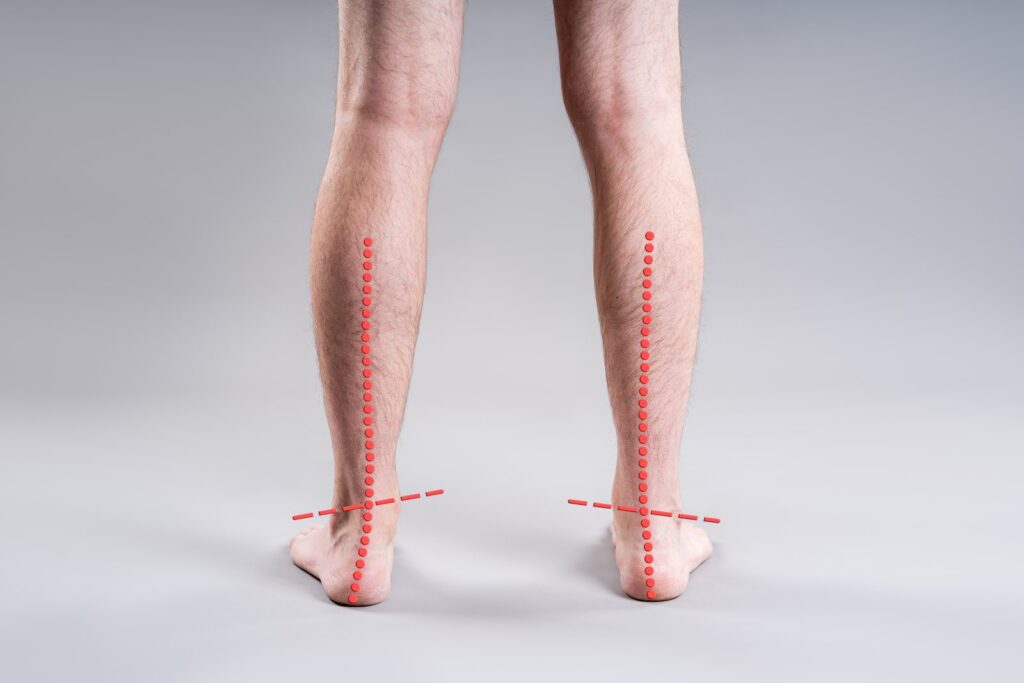
Viewed from behind, a collapsing flatfoot shows the heel drifting outward and “too many toes” visible on the outside of the foot.
The Four Stages of Flatfoot
Stage 1
The tendon is inflamed but the arch still holds. Pain and swelling along the inside of the ankle, especially after activity. The most treatable stage, and the one most easily mistaken for a passing ache.
Stage 2
The tendon has elongated and the arch visibly flattens, but the foot remains flexible: the arch reappears when you rise onto your toes. Most patients seek care here. Joint-sparing correction is still on the table.
Stage 3
The deformity has become rigid. The arch no longer reconstitutes, and arthritis is setting into the joints of the hindfoot.
Stage 4
The collapse has reached the ankle joint itself, tilting it. The most complex stage, requiring the most reconstruction.
Flexible vs. Rigid Flatfoot
| Feature | Flexible Flatfoot | Rigid Flatfoot |
|---|---|---|
| The test | Arch reappears when you rise onto your toes or sit down | Arch is gone in every position; the foot has stiffened |
| What it means | Joints are healthy; the support structures have failed | Joints themselves have adapted and worn |
| Non-surgical care | Often very effective: orthotics, bracing, therapy | Supportive only; cannot restore motion already lost |
| Surgical options | Joint-sparing: HyProCure for candidates, tendon and bone realignment | Reconstruction, with fusion reserved for arthritic joints |
This is the single most important question in your evaluation, and it is answered with a hands-on exam and standing X-rays, which show your bones under real body weight.
You’ve Probably Already Tried…
Arch support insoles from the pharmacy or a big-box store. Motion-control running shoes the salesperson recommended. Rolling your foot on a ball, calf stretches from the internet, ice after long days, and simply standing less, which is a hard trade to live with. Many people have already spent a good deal on store-bought supports before they get here.
The honest assessment: support genuinely helps this condition, and the right custom device is a cornerstone of treatment. But there is a difference between generic cushioning under a collapsing arch and a prescription orthotic engineered from a 3D scan to hold your heel and arch in corrected alignment. And there is a stage beyond which support alone is not enough, because the tendon has failed structurally. Support can slow the collapse, but it does not rebuild an arch that has already fallen or repair a torn tendon.
When to See a Specialist
Come in when inner-ankle pain or swelling has lasted more than a couple of weeks; when your arch looks visibly lower than it used to, or lower than your other foot; when you cannot comfortably rise onto your toes on one side; when your shoes are breaking down along the inner edge; or when store-bought supports have stopped being enough. Because options narrow as the deformity stiffens, it is worth having the foot looked at rather than waiting to see whether it settles on its own.
Same-Day Urgent Appointments Available
Call either office or request an appointment online.
☎ Fredericksburg: (540) 371-2724
☎ North Stafford: (540) 720-0674
Treatment Options
Non-Surgical Care
Custom 3D orthotics. Prescription devices from an in-office 3D scan, engineered to hold the heel and arch in corrected alignment and slow the progression, not just cushion the collapse.
Custom ankle bracing. For more advanced flexible deformities, a custom brace supports the failing tendon and can keep patients comfortable and active for years.
Physical therapy in-house. Targeted strengthening of the posterior tibial tendon and calf, with your program run by our own therapy team and adjusted alongside your medical care.
Anti-inflammatory care and activity modification. Calming tendon flares while the structural plan does its work.
Surgical Correction
HyProCure stent. For the right candidate with a flexible deformity, a small titanium stent is placed through a tiny incision into the natural space between the ankle and heel bones, blocking the abnormal collapse while preserving joint motion. No bones are cut, no joints are fused, the procedure takes minutes, and it is reversible. For feet that qualify, it can mean a considerably quicker recovery than a full reconstruction.
Tendon repair and transfer. Repairing the damaged posterior tibial tendon and, when it is beyond repair, transferring a neighboring tendon to take over its job.
Realignment osteotomy. Repositioning the heel bone to restore the foot’s mechanical axis, commonly combined with tendon work in stage 2 reconstruction.
Fusion, reserved for rigid arthritic feet. When joints are already destroyed by arthritis, fusing them in corrected position relieves pain and restores a stable, plantigrade foot. We recommend it when it is the right operation for the foot, not as a first resort.
What to Expect After Surgery
HyProCure Recovery
Most patients are weight-bearing quickly and back in regular shoes within weeks, with swelling settling over the following months.
Reconstruction Recovery
A staged return: a protected period of roughly 6 to 8 weeks in a cast or boot while bone and tendon work heals, then progressive weight-bearing, then physical therapy with our in-house team, with return to most activities over the following months and full recovery taking up to a year for complex reconstructions. It is a substantial recovery, and you will know your specific timeline before anything is scheduled.
Why Patients Choose Rappahannock Foot & Ankle Specialists
Flatfoot care spans the entire spectrum from an orthotic to a rebuilt foot, and this practice covers all of it under one roof: 3D scanning and custom orthotics made in-house, custom bracing, HyProCure for qualifying candidates, and board-certified and board-eligible surgeons with advanced training in rearfoot and ankle reconstruction for the feet that need more. Your physical therapy happens in our office too, run by the team that talks to your surgeon daily. Since 1986, patients across the Fredericksburg region have trusted us with exactly this kind of staged, honest care.
Meet the Surgeons
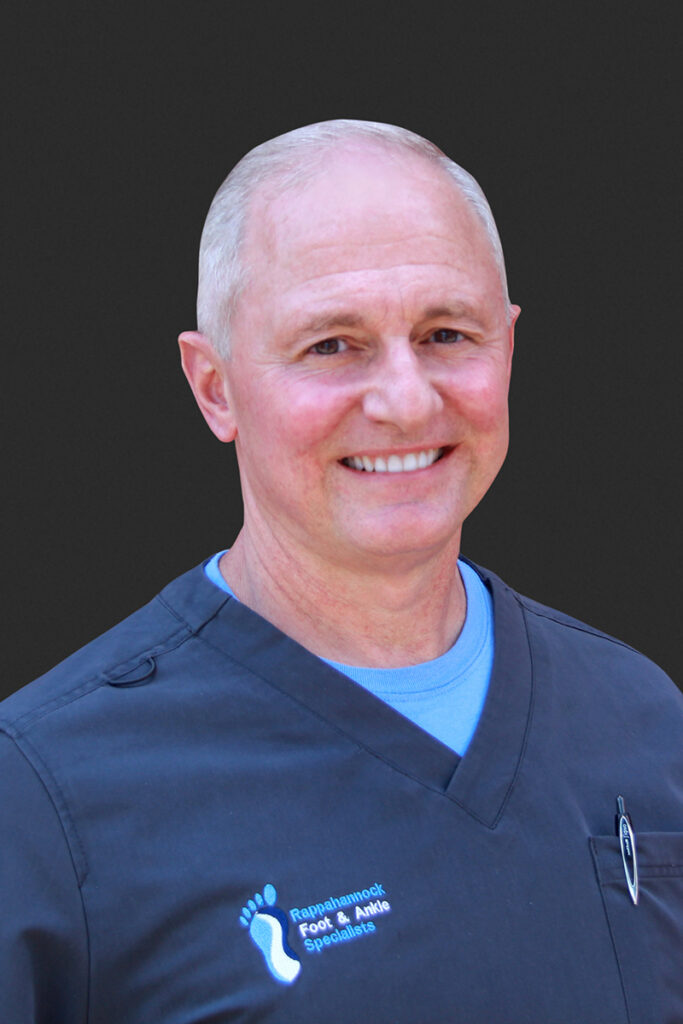
Dr. Michael Donato

Dr. Sunshine Brady-Thomas

Dr. Joel Zarzuela

Dr. Martha Hurley

Dr. Neelum Patel

Dr. Jessica Somma

Dr. Stephen Carley
Emeritus
What Our Patients Say
Frequently Asked Questions
My feet have always been flat. Do I need treatment?
Not necessarily. Painless, flexible flat feet you have had since childhood often need nothing at all. The flatfoot that needs attention is the one that hurts, the one that is visibly changing, or the one making you trade away activities. Pain and progression, not appearance, are the triggers.
Can orthotics rebuild my arch?
No insert rebuilds a fallen arch, whatever a product may promise. What prescription orthotics genuinely do is hold the foot in corrected alignment, relieve the failing tendon, reduce pain, and slow progression, which for many patients is enough for years. For most people they are a sensible first step.
What exactly is HyProCure?
A small titanium stent placed through a tiny incision into a natural space between your ankle and heel bones, where it blocks the abnormal collapse motion at its source. No bone is cut, no joint is fused, motion is preserved, and the procedure is reversible. For qualifying flexible flatfeet it addresses the underlying motion with much less recovery than a reconstruction.
Am I a candidate for HyProCure?
Candidacy depends on your stage, your flexibility, and what standing X-rays show about your alignment. It is a genuine option for many flexible deformities and the wrong one for rigid or arthritic feet, which is exactly what your evaluation sorts out.
Is fusion my only option?
For most flatfoot patients, no. Fusion is the right operation for rigid, arthritic feet, and it does that job well, but flexible deformities usually qualify for joint-sparing correction that preserves motion. If fusion has been presented to you as the only path, you are welcome to come in for a second opinion.
How long is reconstruction recovery, honestly?
Plan on roughly 6 to 8 weeks protected in a cast or boot, a progressive return to weight-bearing, and months of strengthening, with complex reconstructions taking up to a year to feel fully normal. We would rather give you the realistic timeline up front than have it come as a surprise partway through, and we will map out your plan before anything is scheduled.
What happens if I just keep wearing supportive shoes?
For stage 1 and some stage 2 feet, structured support genuinely can hold the line for years, and we will tell you if that is a reasonable plan for you. The consideration is quiet progression: a damaged tendon does not heal back to normal, flexible stages can stiffen over time, and options narrow as that happens. Checking in with a specialist keeps the decision an informed one.
Does insurance cover flatfoot surgery?
Yes, treatment of symptomatic adult acquired flatfoot, including reconstruction, is standard covered care when medically necessary. We verify your benefits before scheduling anything, and we will be straight with you about any component, like certain devices, that your plan handles differently.
My child has flat feet. Is this the right page?
Pediatric flatfoot is its own conversation with its own timeline, and we treat it too. Visit our pediatric flat feet page, or simply bring your child in; growth changes the calculus considerably.
Why is my ankle the thing that hurts if the problem is my arch?
Because the failing structure, the posterior tibial tendon, lives along the inside of your ankle. Inner ankle pain and swelling after activity is very often the first symptom of a collapsing arch, months before the arch itself looks different.
Seeing Someone Earlier Keeps More Options Open
Ready to Schedule?
Request an appointment online or call your nearest office below.
Have Questions First?
Call your nearest office and our team will happily answer.
Not Sure It’s Your Arch?
Inner ankle pain, uneven shoe wear, and tired feet all point the same direction. Standing X-rays settle it in one visit.
Our Locations
Fredericksburg
195 Falcon Drive
Fredericksburg, VA 22408
☎ (540) 371-2724
North Stafford
450 Garrisonville Road, Suite 115
Stafford, VA 22554
☎ (540) 720-0674