SERVING FREDERICKSBURG AND STAFFORD SINCE 1986
Bunion Treatment & Surgery in Fredericksburg, VA
Board-certified and board-eligible foot and ankle surgeons offering traditional, minimally invasive, and Lapiplasty 3D bunion correction, with custom orthotics and physical therapy under the same roof.
☎ Fredericksburg: (540) 371-3338
☎ North Stafford: (540) 659-5067
6 Podiatric Surgeons on Staff • Serving the region since 1986 • 900+ five-star Google reviews • 2 convenient locations
What Is a Bunion?
A bunion, known medically as hallux valgus, is not a growth of extra bone and it is not a callus. It is a structural shift: the long bone behind your big toe (the first metatarsal) gradually drifts outward while the big toe itself leans inward toward its neighbors. The bump you see and feel at the base of your big toe is the head of that drifting bone pushing against your skin, along with the joint being levered out of its socket a little more with every step.
Because a bunion is a bone alignment problem, it behaves like one. It does not respond to creams, it cannot be dissolved, and no pad or splint can push a bone back into position once it has drifted. Bunions are also progressive: the mechanics that created the drift keep working on it, which is why a bunion often becomes larger over the years. The most common driver is inherited foot structure. Tight or narrow shoes accelerate the process and inflame the joint. Bunions run strongly in families, so they can develop even in people who have always worn sensible shoes.

A bunion is a bony bump at the base of the big toe that often becomes red and tender.
How Bunions Progress
Mild
A small bump with occasional soreness in snug shoes. The joint still moves well and the toe has drifted only slightly. At this stage, conservative care is at its most effective.
Moderate
The bump is obvious, redness and aching are regular, and the big toe visibly leans toward the second toe. Shoe choices start shrinking.
Severe
The big toe crowds, overlaps, or pushes under the second toe. Pain occurs even in wide shoes, and the ball of the foot may hurt from carrying weight the big toe no longer accepts.
With Arthritis
Years of the joint operating out of position wear away cartilage. The joint stiffens and aches with every step, and treatment now has to address both alignment and joint damage.
Your Three Surgical Paths
| Feature | Minimally Invasive (MIS) | Lapiplasty 3D Correction | Traditional Bunionectomy |
|---|---|---|---|
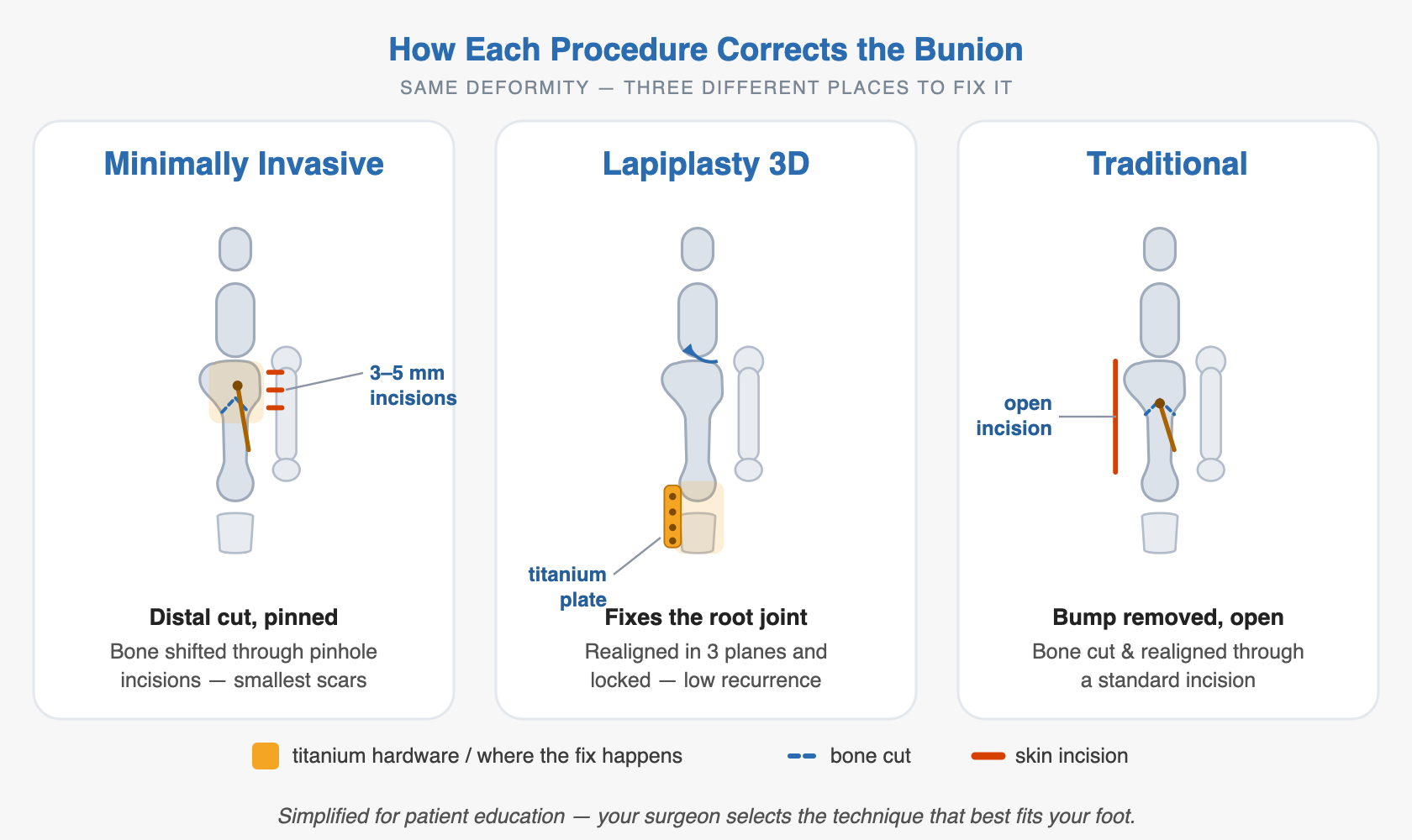
| How it works | Bone realigned through incisions sometimes smaller than a centimeter using specialized instruments and X-ray guidance | Corrects the unstable joint at the root of the bunion in all three dimensions, secured with titanium plates | Bump removed and bone realigned through a standard incision; the proven approach for specific bunion patterns |
| Best for | Mild to moderate bunions; patients prioritizing minimal scarring and early walking | Moderate to severe bunions, hypermobile joints, and recurrences after prior surgery | Certain deformity patterns and bone quality where it remains the right tool |
| Walking again | Typically within days in a protective shoe | Typically within 14 days in a boot | Procedure-dependent; your surgeon sets the plan |
| Scarring | Several tiny marks | Standard incision | Standard incision |
Recovery protocols vary from surgeon to surgeon based on each doctor’s training and experience, so your specific timeline may vary slightly.
You’ve Probably Already Tried…
Most bunion patients arrive at our office having already worked through the home remedy list: wider shoes and stretchy uppers, gel pads and bunion sleeves, toe spacers, drugstore arch supports, night splints from the internet, ice after long days, and ibuprofen before them. Some have also tried over-the-counter “bunion correctors” worn overnight.
Several of those steps genuinely help with pain, and we will build on them. What they cannot do is move bone. A splint can hold your toe straight overnight, but once you stand up, your body weight goes back to work on a joint that is structurally out of position. That is usually why the bump keeps changing despite careful effort. What conservative care can do well is manage pain and slow progression, and for many people that is enough for a long time.
When to See a Specialist
It is time for an evaluation when bunion pain shows up most days rather than only after long ones; when you have already rotated through wider shoes, pads, and inserts without lasting relief; when the bunion is visibly growing or the big toe is crowding the second; when the ball of your foot or your smaller toes have started hurting too; or when you catch yourself declining walks, sports, or shoes you love because of your foot.
A bunion evaluation does not commit you to surgery. It gets you weight-bearing X-rays, a stage, and a full map of your options, most of which are not an operating room.
Same-Day Urgent Appointments Usually Available
Call your nearest office or request an appointment online.
☎ Fredericksburg: (540) 371-3338
☎ North Stafford: (540) 659-5067
Treatment Options
Non-Surgical Care
Custom 3D orthotics. Fabricated from a 3D scan taken in our office, prescription orthotics correct the mechanics that drive the drift, reduce pressure on the joint, and slow progression. They are also how we protect your result after surgery.
Foot strengthening and Correct Toes spacers. A progressive program that encourages better toe alignment and stronger intrinsic foot muscles over time, which many patients find meaningfully reduces day-to-day soreness.
Footwear strategy. Specific guidance on toe box shape, materials, and brands that accommodate your foot, so you know what to look for instead of guessing.
Padding, taping, and anti-inflammatories. Targeted off-loading for flares, and medication or ice when the joint is angry.
Surgical Correction
Minimally invasive bunion correction. Through incisions sometimes smaller than a centimeter, your surgeon cuts and realigns the bone using X-ray guidance, securing it with small screws. Less soft tissue disruption typically means less swelling, less pain medication, and one of the earliest returns to walking of any bunion procedure.
Lapiplasty 3D bunion correction. Most bunions are actually a three-dimensional problem: the bone has drifted sideways, rotated, and become unstable at its base. Lapiplasty corrects all three planes at the foundation joint and secures it with titanium plating, which is why most patients are walking in a boot within about two weeks and why recurrence rates are low.
Traditional bunionectomy. For certain deformity patterns, the time-tested approach of removing the prominence and realigning the bone through a standard incision remains the best-matched tool. Our surgeons recommend it when it is the best match for your foot.
Often combined with hammertoe correction. Because a drifting big toe crowds its neighbors, many patients benefit from straightening a hammertoe in the same surgery: one anesthesia, one recovery.
What to Expect After Bunion Surgery
First two weeks
Rest, elevation, and short indoor walks in a surgical shoe or boot. Depending on the procedure, many patients bear weight immediately. Pain is typically front-loaded into the first few days and manageable with limited medication.
Weeks 2 to 6
Swelling steadily drops, walking distance grows, and follow-up X-rays confirm the bone is healing in its corrected position.
Around week 6
Most patients transition into sneakers and begin rebuilding normal walking mechanics, supported by custom orthotics. Physical therapy may be recommended to help restore strength and motion.
Months 3 to 4
Return to most activities, with high-impact sports cleared last. Residual swelling with long days can persist for months and is normal.
Driving. For a left foot with an automatic transmission, typically around two weeks. For a right foot, usually four to six weeks, since you have to be able to brake hard without hesitation. Two other things decide your date: you cannot drive while you are taking daytime pain medication, and your surgeon has to feel you are ready. Patients who are off pain medication and healing well are sometimes cleared sooner.
Time off work. Desk workers are often back within one to two weeks, some sooner working from home with the foot elevated. Jobs that keep you on your feet run longer, sometimes six weeks or more. Because every job and every surgery is different, we give you a work note built around your specific procedure and your recovery, and we would rather set a conservative return date and move it up than promise a date your healing cannot meet.
Why Patients Choose Rappahannock Foot & Ankle Specialists
This practice has been correcting bunions in the Fredericksburg region since 1986, and the way we are built changes what your care feels like. Your surgeon, your custom orthotics, and your physical therapy team work under one roof, so nothing about your recovery gets lost between offices. Our surgeons are board-certified or board-eligible, with advanced training in forefoot, rearfoot, and ankle reconstruction, and with multiple surgeons on staff, your case is matched to the surgeon whose experience fits it best rather than whoever happens to be available. Our surgeons perform bunion procedures at Stafford Hospital.
Meet the Surgeons
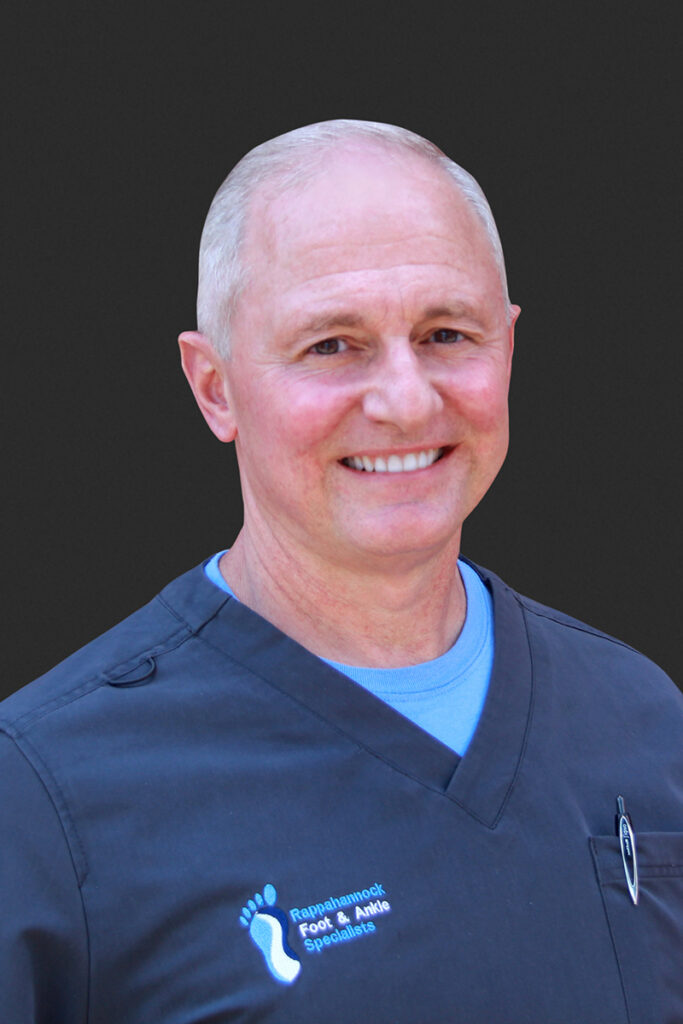
Dr. Michael Donato

Dr. Sunshine Brady-Thomas

Dr. Joel Zarzuela

Dr. Martha Hurley

Dr. Neelum Patel

Dr. Jessica Somma

Dr. Stephen Carley
Emeritus
What Our Patients Say
Frequently Asked Questions
Do I really need surgery, or can orthotics fix my bunion?
Orthotics are excellent at reducing pain and slowing a bunion’s progression, and for many patients that is enough for years. What they cannot do is move a bone that has already drifted; no non-surgical device can. If your pain persists despite good conservative care, surgery is the treatment that corrects the deformity itself, and an evaluation will tell you honestly which side of that line you are on.
How painful is bunion surgery really?
For most patients, it is less than they expect. Between smaller incisions, better fixation, and modern pain protocols, most of our patients need narcotic medication only briefly, if at all, and describe the first week as “sore but manageable.” The old stories of months of misery generally come from procedures done decades ago.
How soon can I walk?
With minimally invasive and Lapiplasty techniques, most patients are walking in a protective shoe or boot within days of surgery, and generally by about two weeks. Traditional procedures vary by pattern. You will know your specific plan before you ever pick a surgery date.
What is minimally invasive bunion surgery?
Your surgeon realigns the bone through incisions sometimes smaller than a centimeter, working with specialized instruments under live X-ray guidance. Because far less soft tissue is disturbed, patients typically see less swelling, less pain, and tiny marks instead of a scar. Not every bunion qualifies, which is what the exam and X-rays determine.
What makes Lapiplasty different?
Older procedures often addressed the bump while leaving the unstable foundation joint alone, which is one reason bunions recurred. Lapiplasty corrects the drift, the rotation, and the instability all at once and locks the correction with titanium plates. Correcting the problem at its root is why most patients walk early and why recurrence is uncommon.
Will my bunion come back?
With modern procedures that correct the underlying alignment, recurrence rates are low. We further protect your result with physical therapy, custom orthotics, and footwear guidance after healing, because the inherited mechanics that led to the first bunion are still there.
How long before I can drive?
For a left foot with an automatic transmission, typically a couple of weeks. For a right foot, plan on four to six weeks, because you need to be able to brake hard without hesitation. Two things also matter: you cannot drive while taking daytime pain medication, and your surgeon has to feel you are ready. Patients who are off pain medication and healing well are sometimes cleared to drive sooner.
How much work will I miss?
Desk workers commonly return within one to two weeks, some sooner working from home with the foot elevated. Jobs that keep you standing run longer, often six weeks or more. Because every job and every recovery is different, we give you a work note built around your actual surgery, and we would rather set a conservative date and move it up than promise one your healing cannot meet.
Does insurance cover bunion surgery?
Yes, bunion surgery is typically covered when medically necessary, meaning documented pain and functional limitation rather than appearance alone. We are in network with Aetna, Anthem BC/BS (including BC/BS Federal and HealthKeepers), CareFirst, Cigna, Humana, Humana Military (TRICARE), MedCost, Medicare, MultiPlan/PHCS, Sentara PPO (Non-Medicaid), UnitedHealthcare, and VA Community Care, and Medicare Advantage plans are accepted with several of these payers. We are not currently accepting new Medicaid patients, or Medicaid patients not seen within the current year. Our team verifies your exact benefits before anything is scheduled.
Can you fix both feet at the same time?
No. We do not recommend correcting both feet at the same time, because operating on both at once increases the risk of a complication and leaves you without a stable foot to recover on. We stage the feet a few months apart so one foot is always solid while the other heals.
Should I see a podiatrist or an orthopedic surgeon?
Board-certified podiatric surgeons operate exclusively on feet and ankles, which means bunion correction is a core part of the practice. Our surgeons also manage everything around the surgery, from orthotics to in-house physical therapy, in one place.
Is it okay to wait?
Waiting is a reasonable choice when your pain is manageable, and many people do well for years. Bunions are progressive, though: over time the toe can drift further, the ball of the foot takes on load it was not built for, hammertoes can develop, and arthritis can set into the joint. Correction done later is often more involved than correction done earlier. An evaluation takes about an hour and commits you to nothing.
Ready to Take the Next Step?
Ready to Schedule?
Request an appointment online or call your nearest office below.
Have Questions First?
Call your nearest office and our team will happily answer.
Not Sure It’s a Bunion?
Come in anyway; ruling things out is what the exam and X-rays are for.
Our Locations
Fredericksburg
195 Falcon Drive
Fredericksburg, VA 22408
☎ (540) 371-3338
North Stafford
450 Garrisonville Road, Suite 115
Stafford, VA 22554
☎ (540) 659-5067