Most people buy shoes by number alone. You grab the size you have worn since college and hope the rest sorts itself out. Then the blisters show up, the arches ache by mid afternoon, and a walk that used to feel easy becomes something you talk yourself into. Your shoes are the only equipment your feet use every single day, and getting the fit right prevents more foot trouble than almost anything else you can do on your own.
Know the Foot You Are Shopping For
Before you think about brands, look at your own feet. Stand up and study the curve along the inside edge between the ball of your foot and your heel (the arch). A foot that flattens toward the floor and leaves almost no curve usually does better in a shoe with a firm midsole and real structure underneath. A tall, rigid arch tends to be a poor shock absorber and is generally happier in something with more give and a well cushioned footbed.
Width deserves as much attention as length, and it is the measurement most shoppers skip. If you have a bunion (the bump that forms when the big toe joint drifts outward), a hammertoe (a toe that buckles upward and catches the top of the shoe), or simply a broad forefoot, what you need is a rounder, deeper toe box, not a longer shoe. Buying a half size up to gain room across the front leaves your heel sliding with every step, and that creates a fresh set of problems.
A Fitting Routine That Takes Five Minutes
- Shop later in the day. Feet swell as the hours pass, so a shoe fitted first thing in the morning can feel tight by dinner.
- Have both feet measured every year or two, for length and for width. The numbers change more than people expect.
- Fit the larger foot. Almost nobody is perfectly symmetrical, and the smaller side can be padded with a thicker sock or an insole.
- Leave roughly a thumb’s width between your longest toe and the front of the shoe. That toe is not always the big one.
- Wear the socks you actually plan to use, lace the shoes fully, and walk the length of the store before you decide.
One rule is worth stating plainly. A shoe that pinches in the store will pinch at home. Materials soften a little with wear, but nothing about breaking in a shoe changes the shape of your foot. If it is not comfortable on the first lap around the sales floor, put it back on the shelf.
Match the Shoe to What You Are Doing in It
Athletic shoes are built around specific motions, and reaching for the wrong one is a common source of sore feet. Running shoes handle repeated forward impact and tend to have a softer, taller heel. Walking shoes flex differently and usually feel more stable underfoot. Court shoes are reinforced for side to side cutting. Lifting shoes have a flat, firm sole on purpose, because a squishy midsole makes a heavy load harder to balance. Pick for the activity that takes up most of your week, and replace the pair once the tread and the midsole pack down.
What Changes as the Years Add Up
Feet do not stay put. The fat pads that cushion the heel and the ball of the foot gradually thin, so the ground feels harder than you remember. Ligaments loosen, letting the foot spread wider and sometimes a size longer. Bunions and hammertoes tend to progress, arthritis stiffens joints, and nerve changes in the feet (neuropathy) can quietly alter your balance.
All of that shifts what a good shoe looks like. Squeeze the back of the shoe before you buy: a heel counter that folds flat gives your foot nothing to stand on. Look for real tread, a closure you can adjust as swelling changes through the day, and enough depth inside to hold an insert. A few favorites are worth retiring, including heels above two inches, narrow pointed styles, thin house slippers, backless sandals, and any pair whose tread has gone smooth. Rocker soles feel plush in the store but can make an unsteady walk worse.
When the Right Shoe Still Is Not Enough
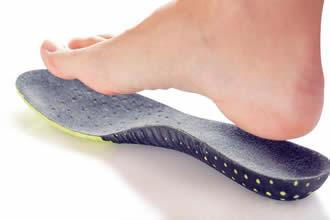
Sometimes a well chosen shoe leaves you with arch pain anyway, or a burning feeling under the ball of the foot, or a callus that keeps rebuilding in the same spot. That usually means pressure is landing unevenly and footwear on its own cannot redistribute it. A custom insert made from a scan of your own foot can. Our Fredericksburg office does the scanning on site, and you can read how the process works on our custom orthotics page.
Bring Your Shoes to Your Next Visit
If you are not sure whether your shoes are helping or hurting, bring in the pair you wear most. The wear pattern on the sole, the creases across the upper, and the shape the insole has taken tell us a great deal about how you load your feet. Rappahannock Foot & Ankle Specialists has been caring for feet in this area since 1986, with offices in Fredericksburg at (540) 371-3338 and North Stafford at (540) 659-5067. Reach out to schedule a visit and we will help you sort out what belongs on your feet.