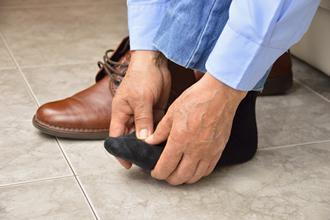
Most of the serious diabetic foot problems we treat did not start out serious. They started as a blister from a new pair of shoes, a callus that got a little thicker every week, or a small split in dry skin at the heel. What made them serious was time and the fact that nobody noticed. If you live with diabetes, the two minutes you spend looking at your feet at the end of the day is genuinely one of the highest value health habits available to you.
Why a Small Sore Behaves Differently
Diabetes changes three things at once, and each one removes a safety net your feet normally rely on.
- Nerves. Elevated blood sugar damages the small nerves in your feet over time (peripheral neuropathy). Pain is an alarm, and when it is muffled you can walk on a pebble in your shoe all afternoon without flinching.
- Circulation. Narrowed vessels mean less blood reaching the toes, and blood is what carries oxygen, nutrients, and antibiotics to a wound. Less flow means slower repair.
- Immune response. Higher glucose blunts how well white blood cells clear bacteria, so a break in the skin that would be nothing on another person can turn into an infection that spreads.
Put those together and you have the reason podiatrists are so insistent about small things. A sore that stays under pressure day after day becomes a diabetic ulcer, and ulcers are the doorway to the outcomes everyone wants to avoid. Catching it while it is still a red spot stops the chain before it starts.
The Two Minute Check, Every Night
Attach it to something you already do, like taking off your shoes or brushing your teeth. Sit under good light and cover the whole foot, not only the parts that are easy to see. Prop a mirror on the floor or use your phone camera for the soles and heels, and if bending or seeing is hard, ask someone at home to be your second set of eyes.
You are looking for anything that was not there yesterday: a red or dark patch, a blister, a crack, a scrape, a stain inside your sock, a nail that has changed color or lifted, a spot warmer than its match on the other foot, or swelling on one side only. Run a hand over the sole too, since a firm callus is often easier to feel than to see.
Skin, Nails, and Shoes
Keep washing simple: warm water, mild soap, and real effort to dry the spaces between the toes, since moisture trapped there invites fungus and skin breakdown. Moisturize the tops, soles, and heels so skin does not crack, and leave the space between the toes alone. Test bath water with your hand or elbow instead of trusting numb feet, and skip heating pads and hot soaks.
Cut nails flat across instead of curving down into the corners, which is how many ingrown toenails get started. Leave corns and calluses to us rather than a blade or a drugstore medicated pad, since those pads carry acid that can burn a hole in numb skin. Wear clean socks daily, keep something on your feet even for a trip across the kitchen at night, and reach inside both shoes before you step into them. Buy shoes late in the day when your feet are largest, insist on a toe box that squeezes nothing, and break new pairs in an hour at a time while you watch what they do to your skin.
What a Diabetic Foot Exam Actually Involves
Plan on a full check annually at minimum, more often if you have neuropathy, past ulcers, or a foot deformity. The visit is painless. We feel the pulses at your ankle and the top of your foot, map where protective sensation has faded using a thin nylon filament and a tuning fork, and examine skin, nails, and the spaces between the toes. We also look at how your toes and arch sit, because bunions, hammertoes, and a collapsing arch build the pressure points that show up later as calluses and ulcers.
Routine nail and callus care with us is not cosmetic when you have diabetes. It is pressure management, and far safer than doing it yourself on numb feet. If we find a pressure problem, options range from padding and shoe changes to a device scanned to the shape of your foot that offloads the spot that keeps breaking down.
Call the Same Day If You See This
- Any open sore, blister, puncture, or crack, no matter how small or how little it hurts.
- Redness spreading from a wound, warmth, foul odor, or drainage on your sock.
- A toe that has turned dark, dusky, or blue.
- New swelling, warmth, or redness in one foot with no injury you can recall.
- Fever or blood sugar readings that climb without explanation, which can be your body reacting to an infection you cannot feel.
Put a Foot Doctor on Your Diabetes Team
Your primary care physician and endocrinologist manage the numbers. A podiatrist manages the place where those numbers do their quietest damage. Rappahannock Foot & Ankle Specialists has cared for this community since 1986, with six podiatric surgeons across our Fredericksburg and North Stafford offices. Call Fredericksburg at (540) 371-3338 or North Stafford at (540) 659-5067, or request an appointment online to set up your yearly foot exam.