Your blood pressure gets measured on your arm, but the effects of a high reading tend to announce themselves at the other end of your body. Your feet sit at the end of the longest stretch of plumbing you have, and they are the first place a supply problem becomes noticeable. If you have been told your pressure is high, or you are taking medication for it, your feet are worth paying attention to.
Why the Trouble Shows Up Farthest From Your Heart
Arteries are meant to flex with every heartbeat. Years of elevated pressure stiffen those walls and roughen their lining, and cholesterol tends to collect where the lining is roughest. That gradual narrowing (atherosclerosis) reduces how much blood can reach a given area. When it happens in the vessels feeding your legs, the condition is called peripheral artery disease, usually shortened to PAD.
Blood carries oxygen, and oxygen is what tissue uses to repair itself. With a reduced supply, muscles complain when you ask them to work, skin thins, nails grow slowly, and a scrape that should close in a week takes a month. High blood pressure also rarely travels alone. Diabetes, high cholesterol, and smoking each push in the same direction, and together they add up faster than any one of them alone.
Signs Worth Mentioning to Us
Circulation problems announce themselves quietly, and most people explain them away as aging or being out of shape. Tell us if you notice any of the following.
- Aching or cramping in your calf or thigh that starts after a fairly predictable walking distance and settles once you stand still.
- Feet that feel cold when the rest of you is comfortable, or one foot noticeably cooler than the other.
- Skin on the lower leg that looks shiny and tight, or that pales when you put your legs up and flushes dusky red when you hang them down.
- Hair thinning or disappearing from your shins, ankles, and toes.
- Toenails that grow more slowly or thicken without an obvious cause.
- Numbness, tingling, or a burning feeling in your toes.
- Any cut, blister, or crack in the heel that has not closed within two weeks.
- Pain across the front of the foot at night that eases when you let the foot hang off the edge of the bed.
What a Circulation Check Involves
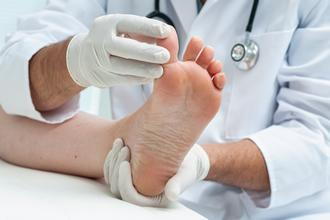
Nothing about this visit is uncomfortable. We start by asking practical questions, such as how far you can walk on a flat sidewalk before your legs ask you to stop and whether hills make it come on sooner. Then we look and feel. We check the pulses on the top of your foot and behind your ankle bone, compare the temperature and color of both feet, and look at the condition of your skin, hair, and nails.
If we want a closer look, our Fredericksburg office has diagnostic ultrasound on site, which lets us watch blood moving through the vessels rather than guessing from the outside. Comparing the pressure at your ankle against the pressure in your arm is another quick, painless way to estimate how much flow is reaching your foot.
We do not manage your blood pressure medication. That belongs with your primary care physician or cardiologist, and we send our findings to them so everyone is working from the same picture. If the narrowing looks significant, we will help arrange a vascular evaluation.
What Helps Between Appointments
- Take your medication on schedule. High blood pressure does not feel like anything, so feeling fine is not evidence that you can skip a dose.
- Keep walking. Regular walking, including the stop and start kind where you rest when your legs cramp and then continue, is one of the better things you can do for leg circulation.
- Give up nicotine in every form. Nothing else you do for your legs will pay off as quickly.
- Look at your feet daily, including the soles and between the toes. A mirror on the floor or a phone camera makes this easy.
- Moisturize dry heels and the tops of your feet, but leave the skin between your toes dry.
- Keep shoes on indoors, and never use a heating pad or a hot soak on feet that feel numb.
Leave bathroom surgery alone as well. Trimming a callus with a razor or digging at a corner of nail carries real risk when blood flow is reduced. A problem you once handled at home, such as an ingrown toenail, is now a reason to call us instead.
Do Not Wait on These
Call the same day for spreading redness, a fever alongside a foot wound, drainage or odor from a sore, or a wound that suddenly looks worse. A foot that becomes cold, pale, and painful over a matter of hours needs emergency care right away, not an office appointment.
Get a Baseline While Things Look Fine
The most useful circulation exam is the one done before anything hurts, because it gives us something to compare against later. Our six podiatric surgeons at Rappahannock Foot & Ankle Specialists see patients at 195 Falcon Drive in Fredericksburg, (540) 371-3338, and at 450 Garrisonville Road, Suite 115, in North Stafford, (540) 659-5067. Contact us to set up an appointment.