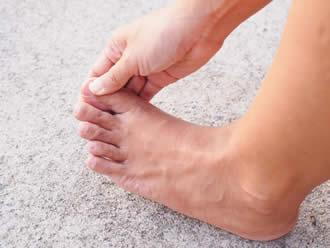
The first few steps out of bed tell you a lot. If your big toe joint will not bend the way it used to, or your ankle feels rusty until you have been up and moving for ten or fifteen minutes, arthritis belongs on the list of explanations. Arthritis means a joint is inflamed and the slick cartilage lining it is wearing thin. Each foot holds more than thirty separate joints, so there is plenty of territory for it to settle into, and what you feel depends on which type you are dealing with.
The kinds that show up in feet and ankles
Four patterns account for most of what we see:
- Wear and tear arthritis (osteoarthritis). Cartilage thins slowly over the years, most often at the big toe joint, the middle of the arch, and the ankle.
- Rheumatoid arthritis. The immune system turns on the lining of the joints. It usually involves several small joints at once, often mirrored on both feet, with stiffness that lingers past breakfast and a run down, flu like feeling.
- Arthritis after an injury. A broken ankle or a damaged joint surface can leave cartilage that never tracks smoothly again. The ache can start years after the cast came off.
- Gout. Uric acid crystals collect in a joint and set off a sudden attack, classically in the big toe and often overnight. The joint turns red, hot, and so tender that a bed sheet across it is too much.
What an irritated joint feels like
The usual report is a deep ache that builds with use and a stiffness that sets in whenever you sit still, then eases once you get going. You may see puffiness along the joint line, feel warmth over it, or notice grinding and catching as the joint moves. Shoes that fit fine last year may press on a bony ridge at the edge of the joint. Over time, particularly with rheumatoid arthritis, toes can drift out of line, curl into a claw or hammertoe shape, and the fat pad under the ball of your foot can slide forward and leave you walking on bone.
Rheumatoid arthritis also goes quiet for stretches and then flares. Enjoy the quiet weeks, but do not read them as proof the joint is safe. Damage can keep building while you feel reasonably well, which is why regular checks matter.
What helps on an ordinary day
- Choose a stiffer sole. A shoe that does not fold in half asks far less bending from a sore big toe joint or midfoot, and a slight rocker helps you roll through the step instead of levering off the painful spot.
- Give your toes room. Depth and width across the forefoot take pressure off knuckles that have started to stand up.
- Keep moving, but trade some of the pounding for cycling, the pool, or an elliptical. Joints do better with steady, lower load activity than with rest.
- Start the day warm. A warm shower, ankle circles, and gentle toe stretches before you stand up take the edge off morning stiffness.
- Ice a hot, puffy joint for fifteen to twenty minutes after a long day, with a thin towel against your skin.
- Anti-inflammatory tablets can settle a flare, but check with whoever manages your medications if you have kidney trouble, ulcers, high blood pressure, or take a blood thinner.
- Losing even a modest amount of weight lowers the load passing through every joint below your waist.
What we can add in the office
Our first job is working out which joint is the problem and what is driving it. Digital X-ray at our Fredericksburg office shows how much joint space is left and whether bone spurs are blocking motion. Blood work through your primary care doctor or rheumatologist separates an inflammatory arthritis from ordinary wear.
From there, most of the work is about redistributing load. A custom orthotic, scanned in three dimensions at our Fredericksburg office, can cushion the ball of the foot, support a collapsing arch, or add a stiff extension under a big toe joint that hurts to bend. A brace or a carbon plate helps when the ankle or midfoot is the trouble spot, and in-house physical therapy at our Fredericksburg office restores motion and strengthens the muscles that steady a loose joint. A cortisone injection can quiet a badly inflamed joint, though the relief is temporary. When a joint is worn past what padding and bracing can handle, surgery to clean out, fuse, or replace it becomes a reasonable conversation, and those cases are done at Stafford Hospital.
Come in before the joint changes shape
Arthritis is far easier to manage while the joint still moves reasonably well and your toes are where they belong. If a joint has been stiff or sore for more than a few weeks, if a toe is drifting, or if a sudden red, hot joint has you wondering about gout, have it looked at. Six podiatric surgeons see patients at Rappahannock Foot & Ankle Specialists. Reach our Fredericksburg office at (540) 371-3338 or our North Stafford office at (540) 659-5067, or contact us to set up a visit.