
Serving Fredericksburg and Stafford since 1986
Gout Treatment in Fredericksburg, VA
A gout attack can take a big toe from perfectly fine to unable to bear a bedsheet in a matter of hours, and the joint damage that repeated attacks leave behind is preventable.
☎ Fredericksburg: (540) 371-3338
☎ North Stafford: (540) 659-5067
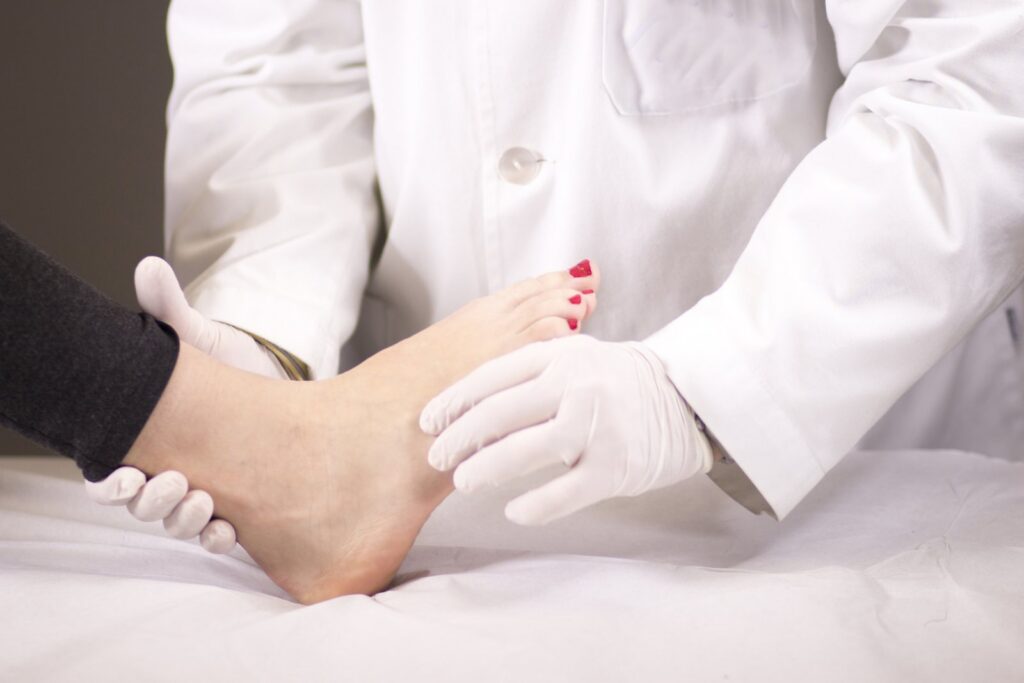
Digital X-ray and in-office ultrasound • Six podiatric surgeons • Two offices, Fredericksburg and North Stafford • Caring for this region since 1986
What Is Gout?
Gout is a form of inflammatory arthritis, and it is a chemistry problem before it is a joint problem. Uric acid is a normal waste product your body makes when it breaks down purines, substances found in your own cells and in some foods. Normally your kidneys clear it. When the level in your blood stays high for long enough, uric acid comes out of solution and forms needle-shaped crystals inside joints. Your immune system does not recognize those crystals, treats them as an invader, and mounts an all-out inflammatory response. That response, not the crystals themselves, is the pain.
The attack is the giveaway. It arrives fast, very often overnight, and it is out of all proportion to anything you did. The joint turns red, hot, and visibly swollen, the skin over it can look shiny and peel as it settles, and it becomes so tender that the weight of a bedsheet is genuinely unbearable. About half of first attacks land in the big toe joint, which has its own name, podagra, but the midfoot, the ankle, and the heel are all common sites, and gout is one of the reasons we tell patients not to assume that sudden foot pain has to be an injury.
Urate crystals form more readily in cool joints, which is why the big toe, the coolest and most distant joint in the body, is gout’s classic target.
A Red, Swollen Big Toe Is Not Always Gout
| Feature | Gout | Bunion | Osteoarthritis | Joint infection |
|---|---|---|---|---|
| How it starts | Sudden, often overnight, peaking within hours | Gradually over years as the joint drifts | Slowly, over months to years | Over hours to a day, usually after a wound, injection, or break in the skin |
| What it looks like | Red, hot, shiny, dramatically swollen | A bony bump at the side of the joint, sometimes red where the shoe rubs | Enlarged and stiff more than red | Red, hot, and swollen, often with fever or chills |
| Pattern over time | Attacks that resolve completely, then return | Steady and progressive; worse in narrow shoes | Steady stiffness that worsens with use | Relentless and worsening; does not settle on its own |
| What it needs | Prompt treatment, then long-term uric acid control | Footwear, orthotics, or surgical correction | Load management, orthotics, sometimes surgery | Same-day medical care |
That last column is the one to take seriously. Gout and a septic joint can look nearly identical from the outside, and they are treated completely differently. If a hot swollen joint comes with fever or chills, or follows a cut, puncture, or procedure near the joint, do not wait it out at home. You can also read our overview of arthritis in the feet and ankles for how the longer-term joint conditions compare.
What Sets Off an Attack
Gout is substantially inherited. Most people with it do not overproduce uric acid; their kidneys simply clear less of it, and that trait runs in families. On top of that baseline, a number of things can push a level over the edge on a given week: dehydration, a stretch of heavy alcohol intake, particularly beer and spirits, a run of purine-rich food such as red meat, organ meats, or shellfish, drinks sweetened with high-fructose corn syrup, rapid weight loss or fasting, an illness or a surgery, and certain medications, diuretics among them. Untreated sleep apnea and kidney disease both raise the risk as well.
The part worth emphasizing is what happens if attacks keep coming. Each episode in the same joint leaves a little less cartilage than it found. Over years, uncontrolled gout erodes bone in a pattern visible on X-ray, and it can deposit chalky lumps of urate called tophi in and around joints and tendons, where they stretch the skin and stop shoes from fitting. None of that is inevitable and none of it is reversible, which is why the conversation about gout should not end when the attack does.
When to See a Specialist
Come in for a first attack, so the diagnosis is properly established rather than assumed. Come in if attacks are recurring, if a joint stays swollen or tender between attacks, if you are seeing lumps develop around a joint or the Achilles tendon, if gout is interfering with your shoes or your walking, or if you have gout and diabetes, kidney disease, or circulation problems, where the stakes are higher. And come in when you are simply tired of losing a week to your own foot.
Most new patients are seen within days, with same-day urgent appointments available. A hot, swollen joint accompanied by fever or chills should be seen the same day, because a joint infection looks very much like gout and cannot wait.
A gout attack should not cost you a week.
Request an appointment online, or call the office nearest you.
☎ Fredericksburg: (540) 371-3338
☎ North Stafford: (540) 659-5067
Treatment Options
Settling the Attack
The priority in the first days.
Getting the load off the joint.
Rest, elevation, and ice make a real difference in the first 48 hours. A stiff-soled or open shoe that keeps the joint from bending, and crutches or a walking aid if you need them, take the mechanical insult out of an already furious joint.
Anti-inflammatory treatment.
Medication aimed at shutting down the inflammatory response is the mainstay of an acute attack, and the right choice depends heavily on your kidney function, your stomach, your heart, and what else you take. That is a conversation to have with a physician rather than a pharmacy aisle.
A targeted injection, in selected joints.
For a single joint that is not settling, or for a patient who cannot safely take oral anti-inflammatories, a corticosteroid injection is one of the options your podiatrist may discuss with you at the visit.
Protecting the Joint Long Term
Where the real win is.
Uric acid control between attacks.
Attacks are the symptom; a sustained high uric acid level is the disease. Long-term urate-lowering therapy is what actually stops the cycle and prevents joint erosion, and it is typically managed together with your primary care physician or rheumatologist, who monitors the level and adjusts the dose. We are glad to coordinate with them.
Custom 3D orthotics.
Once gout has damaged a big toe joint, the pain that lingers between attacks is mechanical. An orthotic made from an in-office 3D scan, with a stiff extension under the first toe, limits how far that joint has to bend at push-off. For many patients this is the difference between walking comfortably and guarding the foot all day.
Footwear and gait.
A roomy toe box and a rocker or stiffened sole take load off a damaged joint. If you have started limping to protect the toe, that altered gait passes strain up to the knee, hip, and back, and it is worth correcting.
Watching the joint over time.
Digital X-ray lets us document what the joint looks like now and compare later, so that erosion is caught as a trend rather than as a surprise.
What Happens at Your Visit
The exam
We look at which joints are involved, how they are involved, and what the surrounding skin and soft tissue are doing, and we take a history that covers family, medication, kidney health, and alcohol, because those are the things that actually predict gout.
Digital X-ray, on site
Taken and read during your visit. X-ray rules out a fracture or advanced arthritis as the cause of the pain and shows whether previous attacks have started to erode the joint.
In-office ultrasound
Ultrasound lets us look at the joint and the soft tissue around it in the same appointment, without sending you elsewhere and waiting on a report.
A plan you leave with
Something for the attack in front of you, and a clear answer about what happens next, including what your primary care physician needs from us. See what to expect as a new patient.
Why Patients Choose Rappahannock Foot & Ankle Specialists
Because gout is a foot problem that needs a foot specialist and a long view at the same time. Digital X-ray and in-office ultrasound mean the diagnosis usually happens at the first visit rather than after a round of referrals. Custom orthotics are scanned and prescribed here, our own physical therapy team is down the hall, and our board-certified and board-eligible podiatric surgeons have been treating this region’s feet since 1986.
We also know where our lane ends. Lowering uric acid for the long haul belongs with your primary care physician or rheumatologist, and we would rather coordinate with them properly than pretend gout is only a toe problem. Browse the full range of foot and ankle care we provide.
Meet the Surgeons

Dr. Michael Donato
Co-owner

Dr. Sunshine Brady-Thomas

Dr. Joel Zarzuela

Dr. Martha Hurley

Dr. Neelum Patel

Dr. Jessica Somma

Dr. Stephen Carley
Emeritus
What Our Patients Say
Frequently Asked Questions
Is gout caused by what I eat?
Diet is a contributor, not the whole story, and this is the single most common misunderstanding about gout. How your kidneys handle uric acid is largely inherited, which is why gout runs in families and why plenty of careful eaters still get attacks. Cutting back on organ meats, shellfish, beer, and sweetened drinks helps at the margins, but for most people diet alone will not control the condition.
Why does it almost always hit the big toe?
Urate crystals form more readily in cooler joints, and the big toe joint is the furthest point from your heart and the coolest joint in the body. It also takes a great deal of load with every step. That combination makes it gout’s favorite target, though the midfoot, the ankle, and the heel are all fair game too.
How do I know it is gout and not an infection?
You often cannot tell from the outside, and that matters, because an infected joint is an emergency and gout is not. Both can produce a red, hot, swollen, exquisitely painful joint. Fever, chills, feeling generally unwell, or a recent wound, injection, or break in the skin near the joint should send you to be seen the same day rather than waiting.
How is gout confirmed?
Confirming gout combines the clinical picture with blood work for uric acid and, in some cases, fluid drawn from the joint and examined under a microscope for urate crystals, which is the definitive test. Bear in mind that a uric acid level drawn during an attack can read normal, so a normal result does not rule gout out. Digital X-ray in our office is used to look at the joint itself and to rule out the other things that make a toe joint hurt.
How long does an attack last?
Untreated, an attack typically builds over several hours, peaks in the first day or two, and then slowly settles over the following week or two. Treatment started early tends to shorten that considerably, which is the practical reason to be seen quickly rather than waiting to see whether it passes.
Can gout damage the joint permanently?
Yes, and this is why gout deserves more respect than it usually gets. Repeated attacks in the same joint erode cartilage and bone, and that damage shows up on X-ray and does not reverse. Longstanding uncontrolled gout can also deposit visible lumps of urate, called tophi, in and around joints and tendons. Controlling uric acid between attacks is what prevents all of it.
Do I need surgery for gout?
Almost never for the gout itself. Surgery comes up only in specific situations, such as a large tophus that will not fit in a shoe or is threatening the skin, or a joint that repeated attacks have destroyed. The overwhelming majority of gout is managed medically.
What can I do during an attack while I wait to be seen?
Get the weight off it, elevate the foot, and use ice for comfort. Wear the roomiest, stiffest-soled shoe you own, or an open shoe if even a sock is intolerable. Keep drinking water. Do not start or stop any uric acid medication mid-attack without speaking to the physician who prescribed it, because changing the level abruptly in either direction can prolong the attack.
Will custom orthotics help?
They will not lower your uric acid, but they can make a joint that gout has already damaged far more comfortable to walk on. A prescription orthotic with a stiff extension under the big toe limits how far the joint has to bend at push-off, which is usually where the pain lives once the acute attack is over.
How fast can I be seen?
Most new patients are seen within days, and we hold same-day urgent appointments. A first gout attack is worth being seen for promptly, both to settle it and to get the diagnosis on record.
Ready to Take the Next Step?
Ready to Schedule?
Request an appointment online or call your nearest office below.
In an Attack Right Now?
Call the office nearest you and ask about a same-day urgent appointment.
Not Sure It’s Gout?
A hot, swollen toe joint has several causes, and the exam sorts them out.
Our Locations
Fredericksburg
195 Falcon Drive
Fredericksburg, VA 22408
☎ (540) 371-3338
North Stafford
450 Garrisonville Road, Suite 115
Stafford, VA 22554
☎ (540) 659-5067